India Pale Ale is one of the most misunderstood and misrepresented beer styles in the world. Strip away the craft beer marketing, and what you have is a centuries-old brewing tradition built on bold hopping, careful fermentation, and a genuinely fascinating origin story. Understanding what IPA is — and why it tastes the way it does — changes how you drink it entirely.
The India Pale Ale, universally shortened to IPA, is far more than a trend. It is a beer style with deep historical roots, a wildly diverse flavor spectrum, and a cultural footprint that now spans every continent. From its origins in 18th-century England to its current dominance in craft brewing scenes worldwide, the IPA has earned its place as one of the defining beer styles of modern gastronomy. Here is what you actually need to know.
Origins of the India Pale Ale: a story built on necessity
The standard story goes like this: British brewers in the late 1700s needed to ship beer to soldiers and colonists in India, and regular ales spoiled on the long voyage around the Cape of Good Hope. So they loaded their brews with hops — a natural preservative — and cranked up the alcohol content. The result survived the months-long journey and arrived in India in drinkable condition. That beer became the India Pale Ale.
The reality is slightly more nuanced, but the core is accurate. George Hodgson of the Bow Brewery in London is frequently credited as an early pioneer, shipping heavily hopped pale ales to the British East India Company's trading posts from around 1780 onward. His beer became enormously popular with the British expatriate community in India, and competitors quickly followed. By the 1840s, Burton-on-Trent brewers like Bass and Allsopp had refined the style further, taking advantage of the town's sulfate-rich water to produce cleaner, crisper IPAs that dominated the market.
The role of hops and alcohol in preservation
The chemistry behind early IPA brewing is straightforward. Hops contain compounds called alpha acids, which have genuine antimicrobial properties. Combined with a higher alcohol content — typically around 6-7% ABV compared to the 3-4% of standard session ales — the beer was significantly more resistant to bacterial spoilage during the four to six month sea voyage. The ships also passed through temperature extremes that would have destroyed lighter beers. IPA was engineered to survive.
The decline and revival of the style
By the late 19th century, refrigeration and faster shipping routes made the preservation argument obsolete. IPA fell out of fashion in Britain, replaced by lighter lagers and milds. It nearly disappeared entirely by the mid-20th century. The revival came from an unexpected direction: American craft brewers in California and the Pacific Northwest during the 1980s and 1990s rediscovered the style, pushed the hop content even further, and created what became the West Coast IPA. That movement triggered a global renaissance that continues today.
Characteristics and flavors that define the IPA
At its core, the IPA is defined by its hop-forward character. Where a lager prioritizes clean malt and carbonation — as explored in this overview of lager beer — the IPA puts the hop front and center. But "hoppy" is a lazy descriptor that covers an enormous range of sensory experiences.
The flavor profile of an IPA depends on three variables: the hop varieties used, when they are added during the brewing process, and the malt backbone supporting them.
Hop varieties and their flavor contributions
Hops are the defining ingredient of any IPA, and the diversity of available varieties is staggering. Cascade hops, the workhorse of American IPAs, deliver grapefruit and citrus. Citra brings tropical fruit — mango, passion fruit, lychee. Simcoe adds pine resin and earthiness. Mosaic covers almost the entire spectrum from berry to stone fruit. British varieties like Fuggles and East Kent Goldings are more restrained, offering floral and earthy notes that recall the original English style.
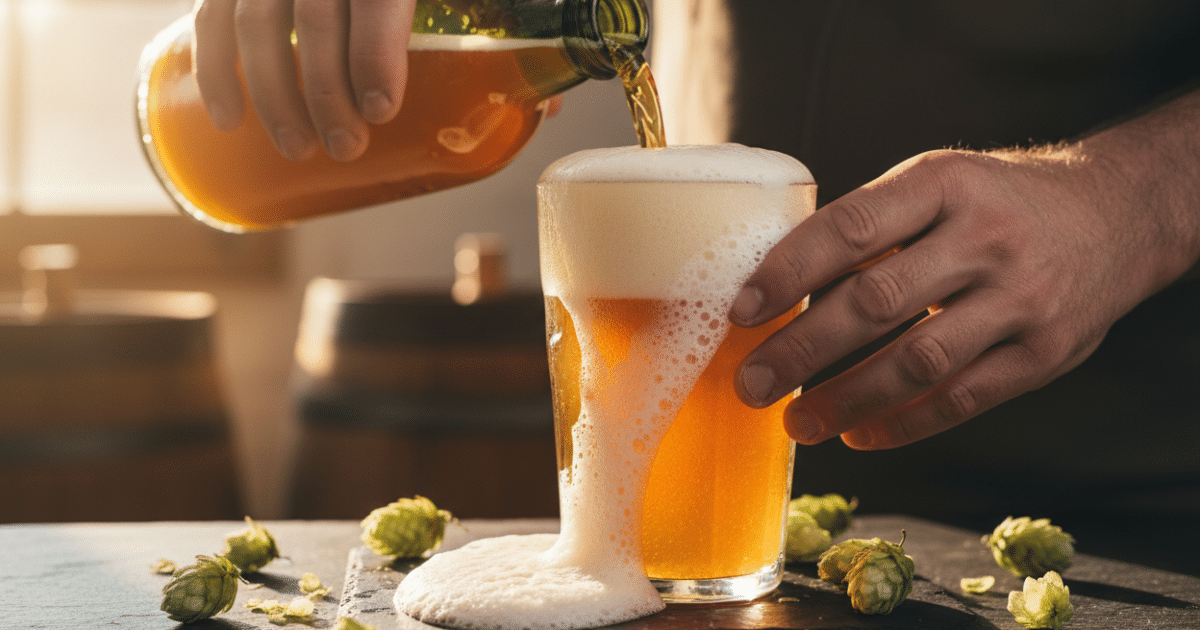
The timing of hop additions matters as much as the variety. Hops added early in the boil contribute bitterness. Hops added late — so-called late hopping or dry hopping — contribute aroma and flavor with minimal bitterness. Modern New England IPAs are almost entirely dry-hopped, which explains their intensely aromatic, low-bitterness character.
Malt, yeast, and the supporting cast
The malt profile in an IPA is deliberately restrained. Brewers typically use pale malts that provide fermentable sugars and a light biscuit backbone without competing with the hops. Some styles incorporate crystal malts for a touch of caramel sweetness, which balances aggressive bitterness. The yeast strain also plays a role: English ale yeasts produce fruity esters that complement floral hops, while American strains ferment cleaner, letting the hops dominate entirely. ABV in modern IPAs ranges from around 5.5% for session versions up to 9-10% for double and triple IPAs.
The **IBU** (International Bitterness Units) scale measures perceived bitterness in beer. A standard lager sits around 10-15 IBU. A classic West Coast IPA lands between 50 and 70 IBU. Some double IPAs push past 100 IBU, though the human palate struggles to distinguish bitterness above that threshold.
Styles of India Pale Ale: not a monolith
Asking what an IPA tastes like is a bit like asking what wine tastes like. The category has fractured into a constellation of substyles, each with its own distinct character and devoted following. Understanding the main variants is the fastest way to find the version that suits your palate.
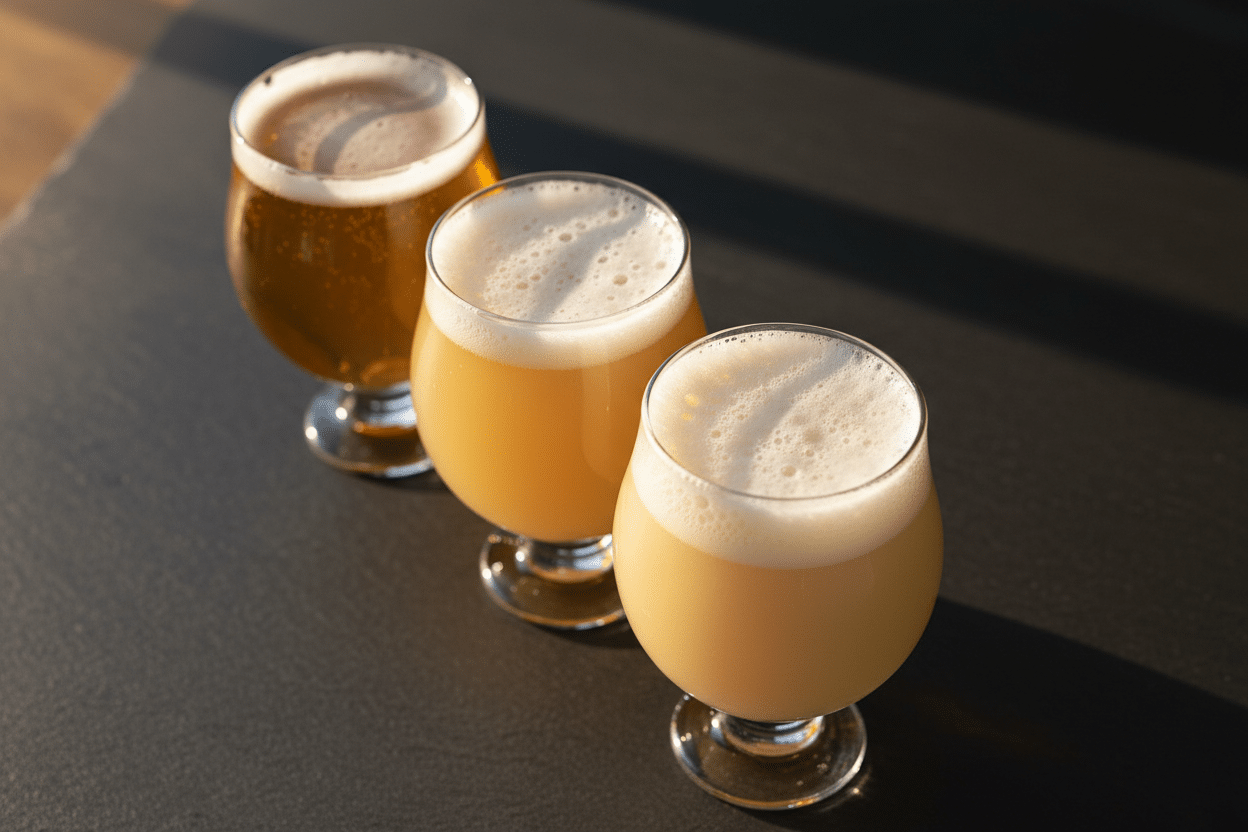
West Coast IPA and English IPA
The West Coast IPA is the archetype for most drinkers. Dry, clear, aggressively bitter, with prominent citrus and pine aromas. The malt is intentionally thin, keeping the focus entirely on the hops. This is the style that defined American craft beer culture from the 1990s through the 2010s. Breweries like Sierra Nevada, Stone Brewing, and Lagunitas built their reputations on it.
The English IPA is the ancestral form. Lower in alcohol, more balanced, with earthy and floral hop notes rather than tropical fruit. It is closer to what would have been shipped to India in the 19th century, and it remains underappreciated outside the UK.
New England IPA and modern variants
The New England IPA (NEIPA) upended the entire category when it emerged from Vermont breweries like The Alchemist around 2011. It is hazy, almost opaque, with a soft and pillowy mouthfeel and explosive tropical fruit aroma. The bitterness is low. The dry-hopping rates are extraordinary — some breweries add more than 500 grams of hops per hectoliter. It divided the craft beer community but conquered the market.
Beyond these two poles, there are Session IPAs (under 5% ABV), Double IPAs (DIPA, pushing 8-10% ABV), Black IPAs (dark malt with hop intensity), Milkshake IPAs (lactose added for sweetness and body), and Brut IPAs (bone-dry, champagne-like). The category keeps expanding because brewers keep experimenting, and the market keeps rewarding them for it.
- Clear, crisp, intensely bitter
- Long shelf life due to high hopping
- Classic craft beer benchmark
- Hazy, soft, low bitterness
- Short shelf life — drink fresh
- Tropical and juicy, not resinous
Food pairings with India Pale Ale: where the bitterness becomes an asset
The hop bitterness in an IPA is not just a flavor — it is a culinary tool. Bitterness cuts through fat, cleanses the palate, and contrasts with richness in a way that few other beverages can match. This makes IPA one of the most versatile beer styles for food pairing, even if it is rarely treated that way.
Pairing IPA with rich and spicy dishes
Fatty, rich foods are the natural territory of a West Coast IPA. A cheeseburger, a plate of nachos loaded with guacamole and sour cream, or a platter of fried chicken — the bitterness scrubs the palate clean between bites, preventing flavor fatigue. The same logic applies to blue cheese and aged cheddars, where the intensity of the cheese meets the intensity of the hops as equals.
Spicy food is another natural partner. The fruity, aromatic character of a NEIPA complements Thai curries, Indian tikka masala, and Mexican street food without amplifying the heat the way carbonated water would. The residual sweetness in a hazy IPA softens spice rather than fighting it.
Lighter pairings that work against expectation
The assumption that IPA only pairs with aggressive flavors is wrong. A well-balanced English IPA alongside grilled salmon or lemon-herb roasted chicken is a genuinely elegant combination, the floral hop notes echoing the citrus in the dish. Sushi with a session IPA is underrated: the clean bitterness mirrors the wasabi, and the carbonation refreshes between pieces.
For dessert, avoid anything too sweet — the bitterness will clash. But dark chocolate with a cacao content above 70% is a classic match, the roasted bitterness of the chocolate aligning with the resinous quality of the hops.
IPA in contemporary beer culture: from niche to mainstream
The IPA's rise from near-extinction to global dominance is one of the more remarkable stories in modern food culture. In the United States, IPA consistently ranks as the best-selling craft beer style by volume, accounting for a significant share of the entire craft segment. The same pattern has repeated in the UK, Australia, Scandinavia, and increasingly in France, Japan, and Brazil.
Craft beer festivals have been central to this expansion. Events like the Great American Beer Festival in Denver and Craft Beer Rising in London dedicate entire sections to IPA variants, and the competition categories for IPA have multiplied to the point where judges now evaluate West Coast, New England, Session, Double, and Specialty IPAs as separate disciplines.
Unlike heavier stouts or barrel-aged beers, most IPAs are best consumed within 60 to 90 days of packaging. Hops are volatile — their aromatic compounds degrade quickly after the can or bottle is sealed. Always check the canning date, not the best-before date.
IPA and the craft brewery ecosystem
The IPA's success is also structural. It is a style that rewards experimentation without requiring years of aging or expensive equipment. A small artisan brewery can release a new IPA variant, gather immediate consumer feedback, and iterate within weeks. This feedback loop has accelerated innovation across the entire beer industry and drawn a younger, more food-literate audience into beer culture — an audience that treats choosing a beer with the same seriousness as choosing a wine.
The calorie question comes up more often now, particularly as this audience becomes more health-conscious. A standard IPA at 6.5% ABV typically contains between 180 and 220 calories per 330ml — more than a light lager, though calorie counts vary significantly across styles and ABV levels. Double IPAs push considerably higher. Session IPAs, by contrast, sit closer to 120-140 calories per serving, making them the pragmatic choice for those who want the flavor without the full caloric load.
The IPA is not going anywhere. Its ability to absorb new techniques, new hop varieties, and new cultural influences while remaining recognizably itself is precisely what has kept it at the center of the global craft beer conversation for more than three decades — and what will keep it there.