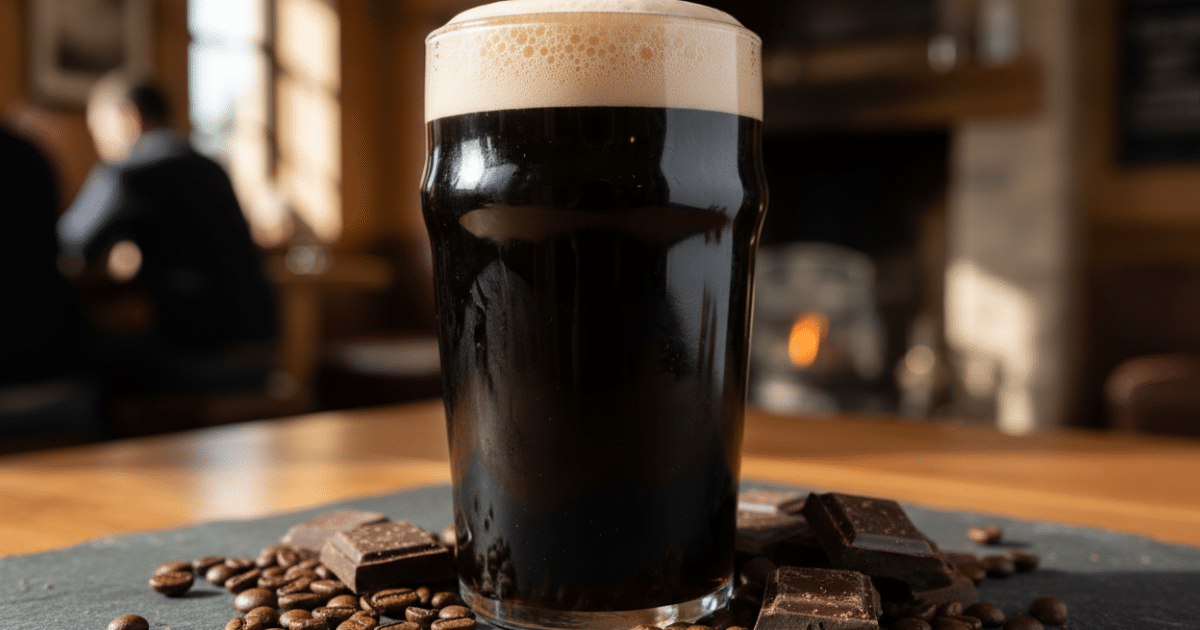
Stout beer is defined by its dark roasted malt character, producing flavors that range from bitter espresso to sweet chocolate and even dried fruit. Far from a single style, it encompasses a family of distinct beers — from the lean Irish dry stout to the formidable Imperial stout. Understanding what makes a stout a stout unlocks one of the most versatile and food-friendly categories in the brewing world.
The stout sits in a peculiar position in beer culture. Widely recognized, often ordered by name (usually Guinness), yet rarely understood beyond its color. Most drinkers know it's dark. Fewer know why, or what that darkness actually means in terms of flavor, brewing technique, and culinary potential. The category deserves a proper examination — not as a curiosity, but as a legitimate pillar of serious beer culture.
The origins of stout beer run deeper than Guinness
When most people think of stout, they think of Arthur Guinness and his brewery at St. James's Gate in Dublin, established in 1759. That association isn't wrong, but it's incomplete. The word "stout" itself predates the Irish tradition by at least a century, and its origins are rooted firmly in England.
From porter to stout: an English evolution
In 18th-century London, a dark ale called porter dominated the working-class drinking scene. Strong, filling, and relatively affordable, porter became the defining beer of the era. "Stout" was initially just a descriptor — a "stout porter" simply meant a stronger, more robust version of the style. By the early 19th century, "stout" had broken free of its modifier status and become a style in its own right.
The British brewing industry refined the category across several decades, developing variations that emphasized roasted bitterness over the sweeter, full-bodied character of porter. Roasted unmalted barley — a key ingredient that distinguishes dry stout from other dark beers — became central to the Irish interpretation of the style, partly for economic reasons tied to 19th-century taxation policies on malted grain in Ireland.
The Guinness effect on global perception
Guinness didn't invent the stout, but it did globalize it. By the 20th century, the brand had become synonymous with the style internationally, which both elevated and narrowed public perception of what stout beer could be. The craft brewing revival of the 1980s and 1990s, particularly in the United States, pushed back against that narrowness and reintroduced the full spectrum of stout varieties to a new generation of drinkers.
The characteristics that define a stout beer
So what is considered a stout beer, technically speaking? The answer lies in a combination of ingredients, brewing process, and sensory profile — not simply in color, which is a common misconception.
Roasted malt and its role in flavor
The defining ingredient of virtually every stout is roasted malt or roasted unmalted barley. These grains are kilned at very high temperatures until they develop deep color and intense flavor compounds — specifically, the same Maillard reaction products found in coffee, dark chocolate, and toasted bread. The result is a beer that carries flavors of espresso, cocoa, dark caramel, and sometimes even a faint smokiness.
Crucially, this roasting process also produces melanoidins, compounds that give stout its characteristic dark brown to near-black color. The darkness is a byproduct of flavor development, not a separate goal. A brewer chasing that color without the roasted grain character won't produce a stout — they'll produce a dyed beer.
Roasted unmalted barley is the signature of Irish dry stout. It contributes a sharp, almost acrid bitterness that distinguishes styles like Guinness from sweeter, malt-forward stouts that use roasted malted barley instead.
Bitterness, body, and ABV range
Stouts span a surprisingly wide range of alcohol content. A standard Irish dry stout sits around 4-5% ABV, while an Imperial stout — the strongest expression of the style — can reach 10-14% ABV or beyond. Body varies accordingly: dry stouts are lean and almost creamy on the palate (particularly when served on nitrogen), while Imperial stouts are dense, viscous, and warming.
Bitterness levels also differ significantly across the family. The IBU (International Bitterness Units) range for stout runs from roughly 25 in a sweet stout to over 60 in some American Imperial variants. What unifies them is the source of that bitterness: roasted grain rather than hops alone.
The main types of stout, ranked by intensity
The stout family is broader than most drinkers realize. Each sub-style carries its own brewing logic and sensory identity.
Irish dry stout and oatmeal stout
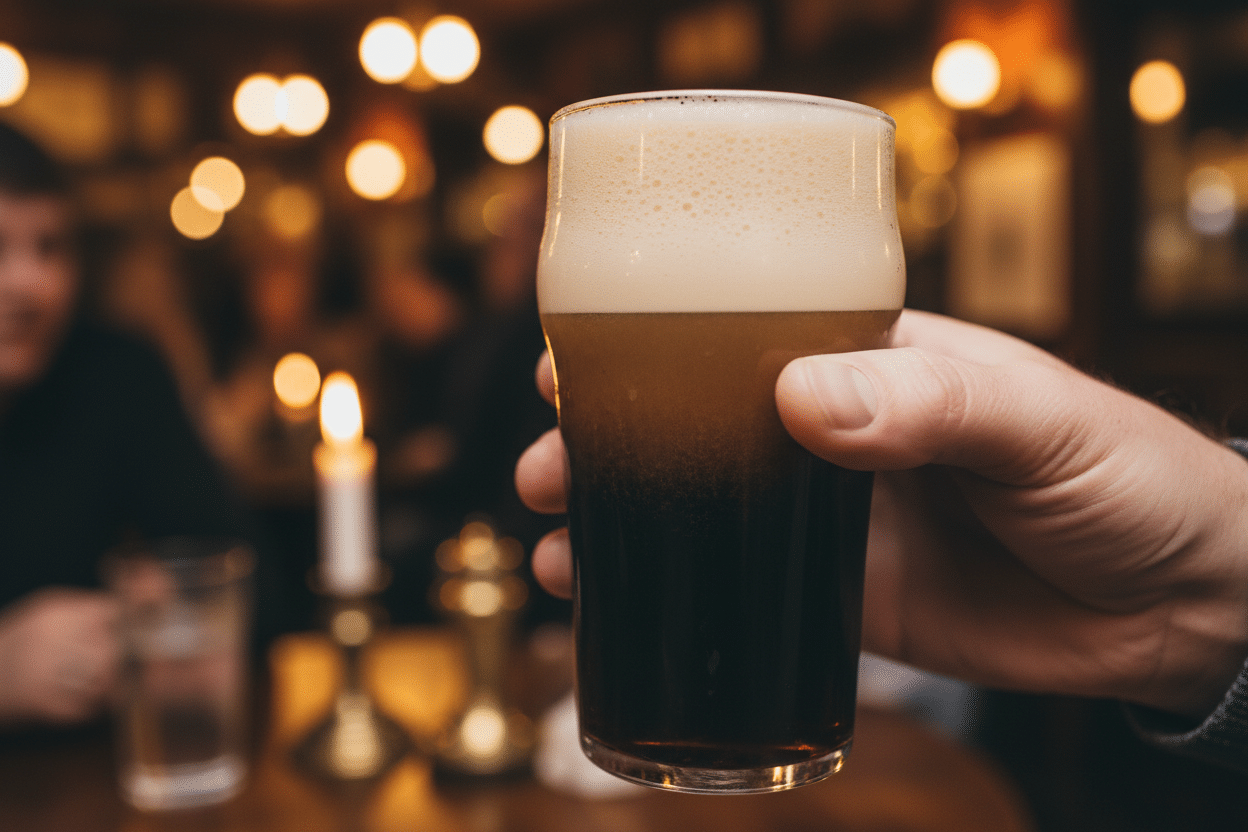
The Irish dry stout is the leanest and most widely consumed form. Characterized by its dry, roasted finish and relatively low ABV, it's built for session drinking. The nitrogen-dispensed version — creamy, with a tight, persistent head — is the format most associated with pub culture. If you've ever wondered about the caloric profile of a pint of Guinness, it's worth noting that the dry, low-ABV nature of the style keeps the numbers lower than most assume.
Oatmeal stout takes the dry stout base and adds rolled oats to the grain bill. Oats contribute a silky, almost velvety mouthfeel without dramatically increasing sweetness. The style was popular in Victorian England and has seen a strong revival in the craft beer scene, where brewers use oats to add texture and a subtle nuttiness.
Sweet stout and milk stout
Milk stout (also called sweet stout) introduces lactose — an unfermentable milk sugar — to the brewing process. Because yeast cannot digest lactose, it remains in the finished beer as residual sweetness. The result is a stout with a noticeably softer, creamier character and flavors that lean toward chocolate milk and vanilla rather than espresso.
This is arguably the most approachable entry point into bière noire territory for drinkers who find the roasted bitterness of dry stout challenging. Brands like Left Hand Milk Stout from Colorado have built substantial followings around this sub-style.
Imperial stout: the heavyweight of the category
The Imperial stout (or Russian Imperial stout, historically) is a different beast entirely. Originally brewed in 18th-century England for export to the court of Catherine the Great of Russia, it was designed to survive long sea voyages — hence the elevated ABV and intense concentration of flavor.
Modern Imperial stouts are among the most complex beers produced anywhere. Flavors of dark fruit, molasses, bourbon (especially in barrel-aged versions), dark chocolate, and roasted coffee layer over one another in a beer that often improves with years of cellaring. The style has become a showcase piece for craft breweries, with releases from producers like Founders (KBS), Goose Island (Bourbon County Brand Stout), and Nogne Ø commanding serious attention from beer enthusiasts.
- Exceptional flavor complexity across all sub-styles
- Highly versatile for food pairing
- Wide ABV range suits different occasions
- Craft brewing has dramatically expanded the style’s creativity
- Roasted bitterness can be off-putting for new drinkers
- Dark color creates psychological associations with heaviness
- Imperial stouts can be expensive and hard to find
Stout and food: a pairing logic that actually works
The accords mets-bière conversation has matured considerably over the past decade, and stout occupies a privileged position in that discussion. Its flavor profile creates genuine culinary synergies that go well beyond the obvious "dark beer with meat" generalization.
Complementary pairings: matching roast with roast
The roasted character of stout aligns naturally with foods that share similar Maillard-reaction flavors. A dry stout alongside a char-grilled ribeye works because both carry that same deep, slightly bitter, caramelized quality. The beer's carbonation cuts through fat, and its bitterness acts as a palate cleanser between bites.
Oysters and stout is a classic combination with genuine historical roots — oyster stouts were literally brewed with oysters as an ingredient in the 19th century. The minerality and brininess of fresh oysters contrast sharply with the roasted, bitter profile of the beer, creating a balance that's more elegant than it sounds on paper.
Chocolate-based desserts are the other obvious match. A milk stout with a dark chocolate fondant, or an Imperial stout alongside a flourless chocolate cake, creates a complementary pairing where the beer amplifies the dessert's cocoa notes without competing with them.
Contrast pairings: stout against richness
Contrast pairings work equally well. A rich, creamy beef and Guinness stew — where the stout is both a cooking ingredient and the accompanying drink — is the textbook example. But the principle extends further: stout against the fat richness of aged cheddar, against the sweetness of barbecued pulled pork, or against the caramelized crust of a crème brûlée.
Unlike lager beer, which tends to work best as a palate-refreshing counterpoint to food, stout actively engages with the flavors on the plate. It's a more assertive partner at the table — which is exactly why it rewards thoughtful pairing.
Stout's place in contemporary craft beer culture
The stout's position in craft beer culture today is paradoxical. On one hand, it's one of the most commercially visible beer styles in the world, thanks to Guinness. On the other, within the craft brewing community, it represents one of the most experimental and boundary-pushing categories available to brewers.
The craft stout renaissance
Since the early 2000s, American craft breweries have treated the Imperial stout in particular as a canvas for innovation. Barrel aging — resting stout in bourbon, rye, rum, or wine barrels for months or years — has become a defining technique of the American craft scene. The resulting beers absorb wood tannins, residual spirits, and complex secondary flavors that push the style into genuinely novel territory.
Adjunct stouts have proliferated alongside barrel-aged versions: beers brewed with coffee, vanilla, cacao nibs, chili, coconut, peanut butter, and combinations thereof. Some of these experiments are gimmicks. Many are genuinely excellent. The willingness to experiment reflects the stout's underlying strength as a base — its roasted backbone is assertive enough to integrate powerful additions without losing coherence.
If you’re new to stout, start with an oatmeal or milk stout rather than an Imperial. The lower ABV and softer bitterness make for a far more accessible introduction to the style’s core flavors before moving toward more intense expressions.
Stout at the table and at the festival
Beer festivals have become a primary venue for discovering the full range of brassage artisanal in the stout category. Events dedicated exclusively to dark beer — such as Dark Lord Day in Indiana or the Great British Beer Festival — draw thousands of enthusiasts specifically for stout and porter releases. The secondary market for rare Imperial stouts has grown to rival that of natural wine and limited whisky releases, with bottles trading at significant premiums online.
What this signals, more than anything, is that the stout has shed whatever image problem it once had. The drinker who once avoided it for being "too heavy" is now often the same person hunting down a barrel-aged variant from a small-batch brewery. The category's depth — from a 4.2% dry stout on nitrogen to a 14% bourbon-barrel Imperial — means there's a stout for virtually every palate, occasion, and plate. That range is its greatest strength, and the reason it continues to command serious attention from both brewers and the people who think carefully about what they drink.