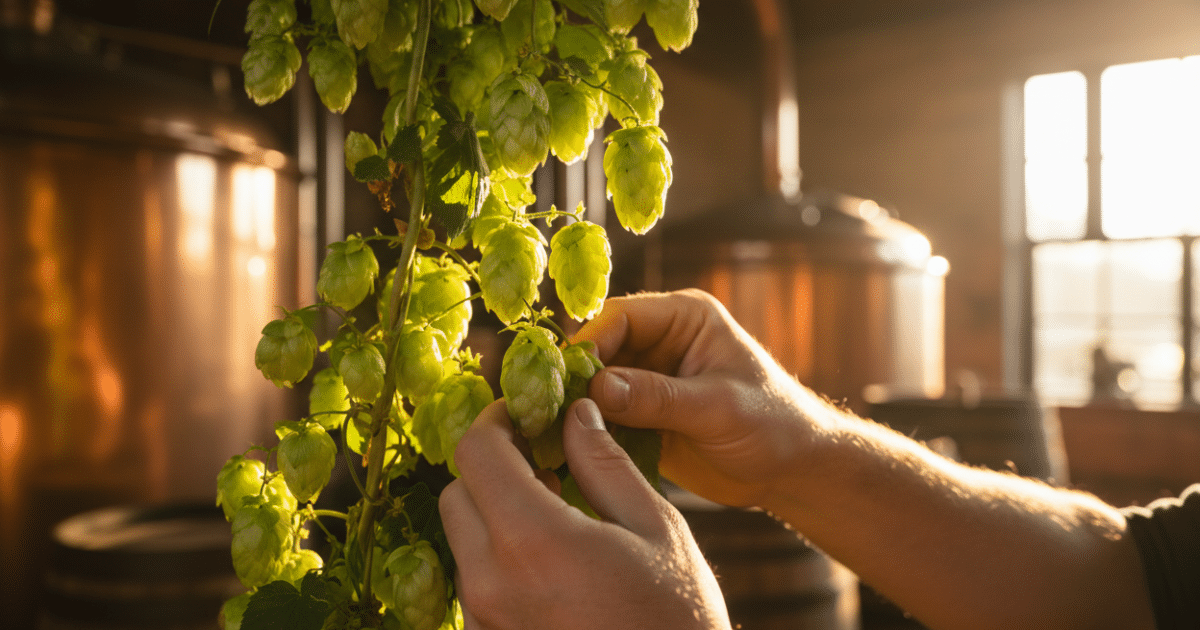
Hops are the cones of the Humulus lupulus plant, and they function as the primary flavoring agent in beer — delivering bitterness, aroma, and preservation properties that define nearly every style on the market. Understanding how different hop varieties work, and when they're added during brewing, is the difference between drinking a beer and actually tasting it.
Mention hops to most people and they'll nod vaguely, picturing something bitter. But that's barely scratching the surface. Hops are arguably the most complex ingredient in a brewer's toolkit — more nuanced than malt, more variable than yeast, and far more consequential to the final flavor profile than most drinkers realize. From the floral citrus punch of an American IPA to the subtle earthiness of a classic English bitter, what you taste in the glass traces back, in large part, to which hops were used, how much, and when they hit the kettle.
This guide breaks down what hops actually are, which varieties matter most, how they're used throughout the brewing process, and why pairing hop-forward beers with food deserves far more attention than it typically gets.
What hops are and why they matter in beer
The hop plant, Humulus lupulus, is a vigorous climbing perennial native to temperate regions across Europe, Asia, and North America. What brewers actually use are the female flower cones — papery, pine-cone-shaped structures packed with lupulin glands. Those glands are the real prize: they contain the alpha acids, beta acids, and essential oils responsible for bitterness, aroma, and the antimicrobial properties that help beer resist spoilage.
Botanically, hops belong to the Cannabaceae family, making them distant relatives of cannabis — a fact that surprises people but explains the similar resinous, sometimes earthy character that certain hop varieties carry. The plant grows aggressively, reaching up to 6 meters in height during a single growing season, and is harvested once a year, typically between August and September in the Northern Hemisphere.
The chemistry behind hop character
Alpha acids — primarily humulone, cohumulone, and adhumulone — don't contribute bitterness in their raw state. They need heat to isomerize, transforming into iso-alpha acids during the boil. The longer hops boil, the more bitterness is extracted. Essential oils, by contrast, are highly volatile: most evaporate with prolonged heat, which is why aroma hops are added late in the process or after the boil entirely.
Beta acids contribute less directly to bitterness but oxidize slowly over time, adding complexity to aged beers. This chemical interplay is what makes hop timing so critical — and what separates a well-built beer from a flat, one-dimensional one.
Lupulin glands make up only a small fraction of the hop cone by weight, but they contain virtually all of the compounds that give beer its bitterness and aroma. Pelletized hops concentrate these glands by removing much of the leaf material, which is why pellets have become the industry standard.
The major hop varieties and their flavor profiles
Not all hops taste alike — not even close. The world of hop varieties has expanded dramatically over the past three decades, driven largely by the craft beer movement's demand for more expressive, differentiated flavor profiles. Today, brewers choose from hundreds of named varieties, each with its own alpha acid content, oil composition, and sensory character.
Noble hops and the European tradition
The so-called Noble hops — Saaz, Hallertau Mittelfrüh, Tettnang, and Spalt — form the backbone of traditional European lager and pilsner brewing. These varieties are low in alpha acids (typically 3-5%) and high in the essential oil humulene, which produces the refined, herbal, and slightly spicy character that defines a Czech pilsner or a German Märzen. Saaz, grown in the Žatec region of the Czech Republic, is perhaps the most recognized hop in the world — its delicate floral and earthy notes are inseparable from the identity of Bohemian-style lagers.
For anyone curious about how lager styles are defined and distinguished, the role of Noble hops is central to that conversation. Their restrained bitterness and aromatic subtlety are precisely what allow malt character to come forward in those styles.
American hops and the craft beer revolution
American hop breeding programs, particularly those run through the Hop Research Council and universities in the Pacific Northwest, produced a generation of varieties that rewired expectations entirely. Cascade, Centennial, Chinook, Citra, and Simcoe are the names that built the craft IPA category.
Cascade — the variety that launched Anchor Liberty Ale in 1975 and subsequently defined American pale ales — delivers a signature grapefruit and floral character that remains one of the most recognizable beer aromas in the world. Citra pushes further into tropical territory: passion fruit, mango, and lime zest, with alpha acid levels reaching 11-13%, making it effective as both a bittering and an aroma hop. Simcoe splits the difference, offering pine and earthy resin alongside tropical fruit — a complexity that's made it a staple in double IPAs and West Coast-style ales.
Southern Hemisphere and emerging varieties
New Zealand and Australian hops have carved out their own identity over the past fifteen years. Nelson Sauvin from New Zealand is unlike anything grown in Europe or North America — its white wine and gooseberry character is immediately distinctive and polarizing in the best possible way. Galaxy from Australia delivers intense passion fruit and citrus with a clean finish that's made it one of the most sought-after craft beer hops globally.
- Efficient for bittering — fewer hops needed
- Cost-effective for high-volume brewing
- Consistent bitterness extraction
- Suitable for bold, bitter styles like double IPAs
- Higher cost per unit of bitterness
- Require larger quantities for late additions
- Volatile oils degrade faster in storage
- Less efficient if used early in the boil
The role of hops in the brewing process
How hops are used matters as much as which hops are chosen. Brewing techniques around hop additions have become increasingly sophisticated, with brewers treating timing almost like a culinary spice rack — each addition serving a distinct function.
Bittering additions and the boil
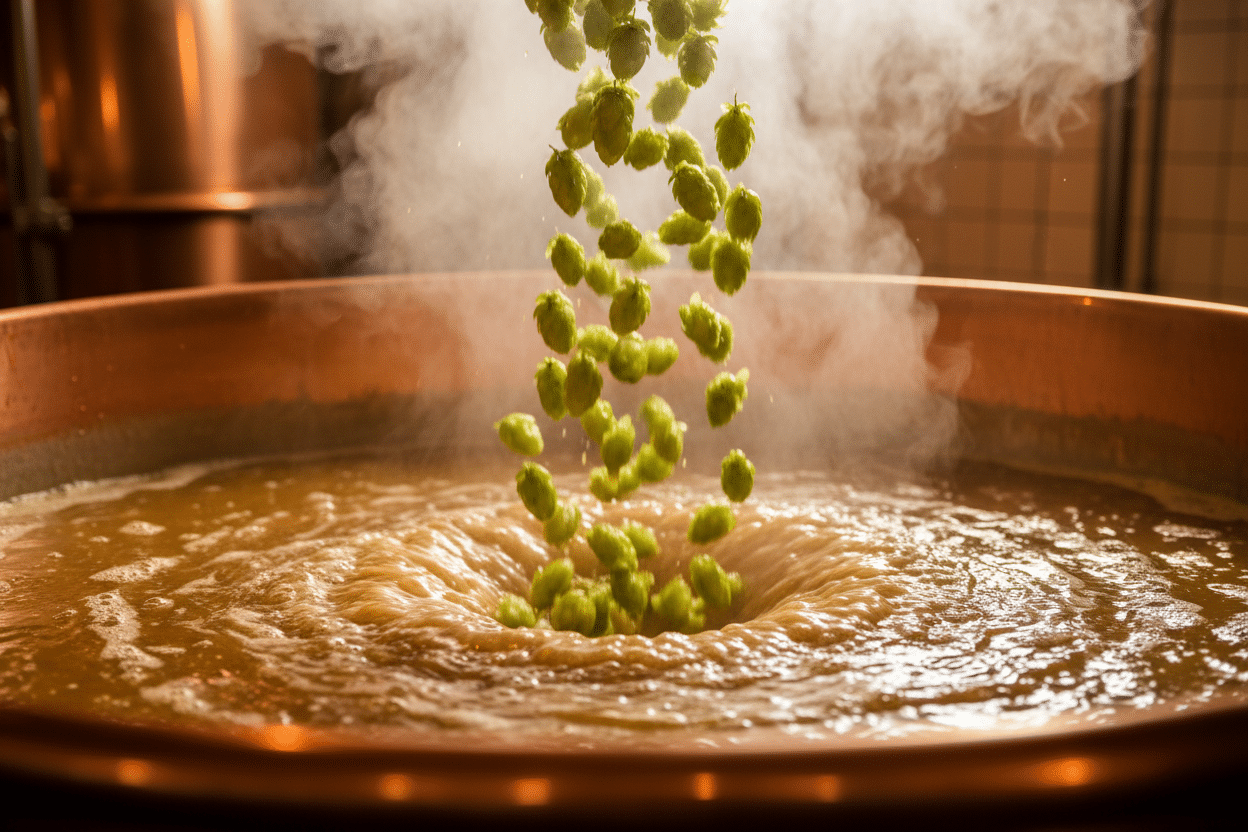
The first hop addition typically happens at the start of the 60-90 minute boil. These bittering hops spend the most time in contact with hot wort, allowing maximum isomerization of alpha acids. At this stage, aroma is largely irrelevant — the volatile oils will evaporate anyway. Brewers choose high-alpha varieties like Magnum or Columbus for bittering additions because they deliver consistent IBUs (International Bitterness Units) efficiently and economically.
The bitterness level of a finished beer is expressed in IBUs: a light lager might sit around 8-12 IBUs, a session pale ale around 30-40, and an imperial IPA can push past 100 — though perceived bitterness depends heavily on residual sweetness from malt, meaning a high-IBU beer with rich malt body can taste more balanced than its number suggests.
Late additions, dry hopping, and modern techniques
The real flavor complexity in modern craft beer comes from late-stage hop additions. Flameout additions (hops added when the heat is turned off) extract essential oils with minimal bitterness. Whirlpool hopping — adding hops as the wort spins in a whirlpool after the boil — has become standard practice in hazy IPA production, extracting intense aroma compounds at sub-boiling temperatures.
Dry hopping is the technique that defines the hazy or New England IPA style: hops are added directly to the fermenter during or after fermentation, at room temperature, with no heat involved. This extracts pure aroma — the tropical, juicy, resinous character that's become the signature of the style — without adding any additional bitterness. Some breweries dry hop multiple times at different stages, a practice called double dry hopping (DDH), which produces the intensely aromatic, hazy pints that have dominated craft beer trends since the mid-2010s.
Hop bursting takes a different approach: instead of a single bittering addition early in the boil, brewers use massive quantities of aroma hops in the final minutes, relying on sheer volume to generate bitterness while simultaneously loading the beer with flavor compounds.
Biotransformation is a phenomenon where active yeast chemically modifies hop compounds during fermentation, creating entirely new aroma molecules. This is one reason why the same hops can produce dramatically different results depending on the yeast strain used — and why hazy IPAs fermented with certain strains develop their characteristic tropical intensity.
The functional properties of hops beyond flavor
Hops do more than taste good. Their antimicrobial properties — specifically the iso-alpha acids — inhibit the growth of gram-positive bacteria, which is why beer has historically been a safer drink than water in many parts of the world. This preservation function was the original reason hops displaced other bittering herbs (collectively known as gruit) in European brewing during the medieval period.
Hops and beer stability
Beyond microbial protection, hops contribute to foam stability. The iso-alpha acids bind with proteins in the beer to create a more persistent head — the kind of tight, creamy foam that sits atop a well-poured pint and clings to the glass as it's consumed. This is one reason hop-forward beers often display better head retention than low-hop styles.
Hops also act as a natural clarifying agent. During the boil, hop matter binds with proteins that would otherwise cause haze and off-flavors in the finished beer, precipitating them out in a mass called the cold break. The result is a cleaner, more stable product — a function that's easy to overlook when the conversation focuses entirely on flavor.
The caloric impact of hops themselves is negligible — they add virtually no calories to the finished beer. If you're thinking about the caloric content of specific beers, that comes primarily from residual sugars and alcohol, not from the hops.
Pairing hop-forward beers with food
The aromas and flavors of hops aren't just interesting in isolation — they're genuinely useful at the table. Hop bitterness functions much like acidity in wine: it cuts through fat, cleanses the palate, and brings contrast to rich or heavily seasoned dishes.
Bitter beers and rich, fatty foods
A heavily hopped West Coast IPA — think 60-70 IBUs, dry and resinous — is the natural companion to fatty proteins. Grilled lamb chops, aged cheddar, duck confit: the bitterness acts as a counterweight, preventing the palate from being overwhelmed by fat. The same principle applies to spicy food — hop bitterness doesn't amplify heat the way carbonation can; it provides a momentary contrast that makes the next bite more interesting.
Aromatic hops and cuisine pairings
Tropical hop varieties — Citra, Galaxy, Mosaic — create unexpected synergies with Asian-inspired dishes. The citrus and passion fruit notes in a hazy IPA echo the lime, lemongrass, and fish sauce elements in Thai or Vietnamese cooking. This isn't a coincidence: shared aromatic compounds (particularly myrcene and linalool) create a sensory bridge between the beer and the food.
Saaz-hopped pilsners, with their delicate herbal character, pair far better with lighter fare — fresh seafood, soft cheeses, charcuterie — where a more aggressive hop profile would dominate rather than complement. The rule is simple: match the intensity of the beer to the intensity of the dish, and let the specific hop flavor profile guide the direction of the pairing. A brewer who understands their hops is essentially a flavor architect, and the table is where that architecture gets tested.