A pint of Guinness contains approximately 198 calories, making it one of the lighter options among full-flavored dark beers. But reducing this iconic Irish stout to a calorie count misses the point entirely. Guinness is a cultural artifact, a culinary ingredient, and a social ritual that has shaped drinking culture across centuries and continents.
Few beverages carry as much symbolic weight as Guinness. Walk into a pub in Dublin, Lagos, or New York, and the sight of that distinctive dark liquid settling beneath a creamy white head signals something beyond thirst. It signals belonging. The question of how many calories are in a pint of Guinness is worth answering — and we will answer it precisely — but the more interesting story is what surrounds that number.
The origins of Guinness and its place in Irish culture
The story begins in 1759, when Arthur Guinness signed a 9,000-year lease on a disused brewery at St. James's Gate in Dublin. The rent: £45 per year. By any measure, it was an audacious bet on the future. Arthur Guinness initially brewed ale, but the shift to porter — a dark, roasted style of beer that had grown popular in London — proved to be the defining pivot. By the early nineteenth century, the St. James's Gate brewery was producing porter at a scale that made it one of the largest breweries in the world.
From Dublin to a global symbol of Ireland
What Arthur Guinness built was not merely a commercial enterprise. Over the following two centuries, the brand became inseparable from Irish identity. During the Great Famine of the 1840s, Guinness remained one of the few stable employers in Dublin. The brewery provided housing, pensions, and medical care for its workers at a time when such provisions were extraordinary. This social dimension embedded the company into the fabric of Irish society in a way that few corporations have ever achieved.
The famous advertising slogan "Guinness is Good for You," launched in 1929, reflected a genuine cultural belief of the era. Doctors recommended stout to blood donors and post-operative patients. Nursing mothers were sometimes advised to drink a pint. The science behind these recommendations was questionable, but the cultural resonance was real and lasting.
The ritual of the pour
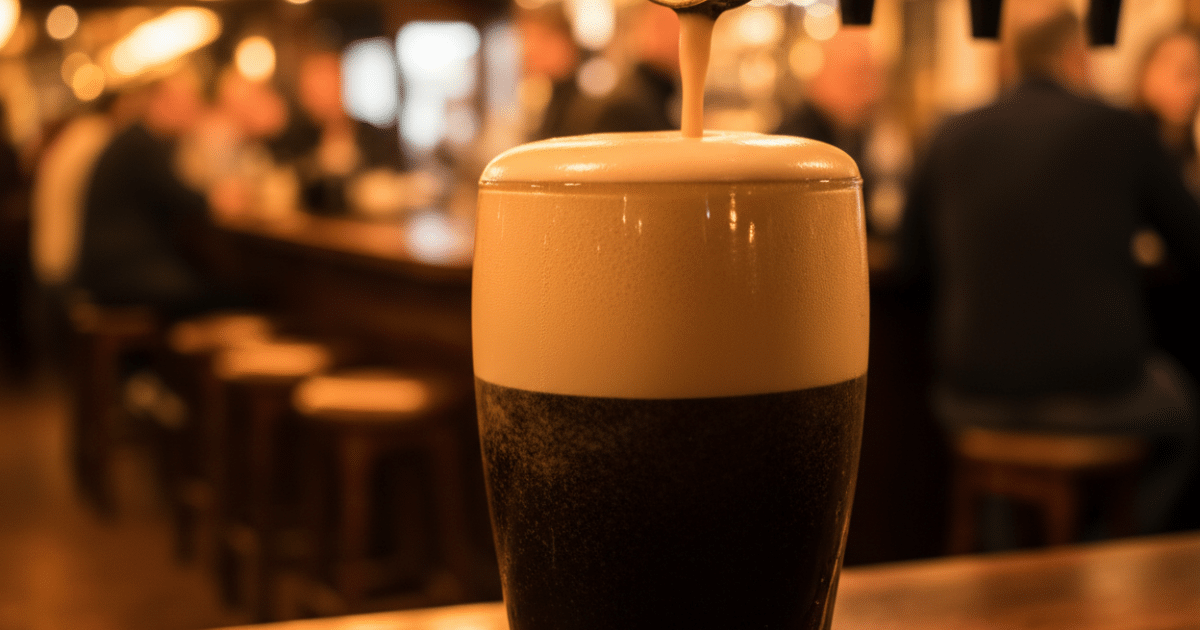
No discussion of Guinness and Irish culture is complete without addressing the pour. The 119.5-second pour — a two-stage process involving a partial fill, a rest, and a final top-up — is not marketing theater. It allows nitrogen bubbles to cascade downward through the pint, creating that signature surge before the beer settles into its characteristic dark body and tan head. In Ireland, asking a bartender to rush a Guinness pour is a genuine social offense. The wait is part of the experience.
The composition of Guinness and what drives its flavor
Understanding how many calories are in a pint of Guinness requires understanding what goes into the glass. The ingredient list is deceptively simple: water, barley, hops, and yeast. But the process transforms these raw materials into something far more complex.
Roasted barley: the key to color and character
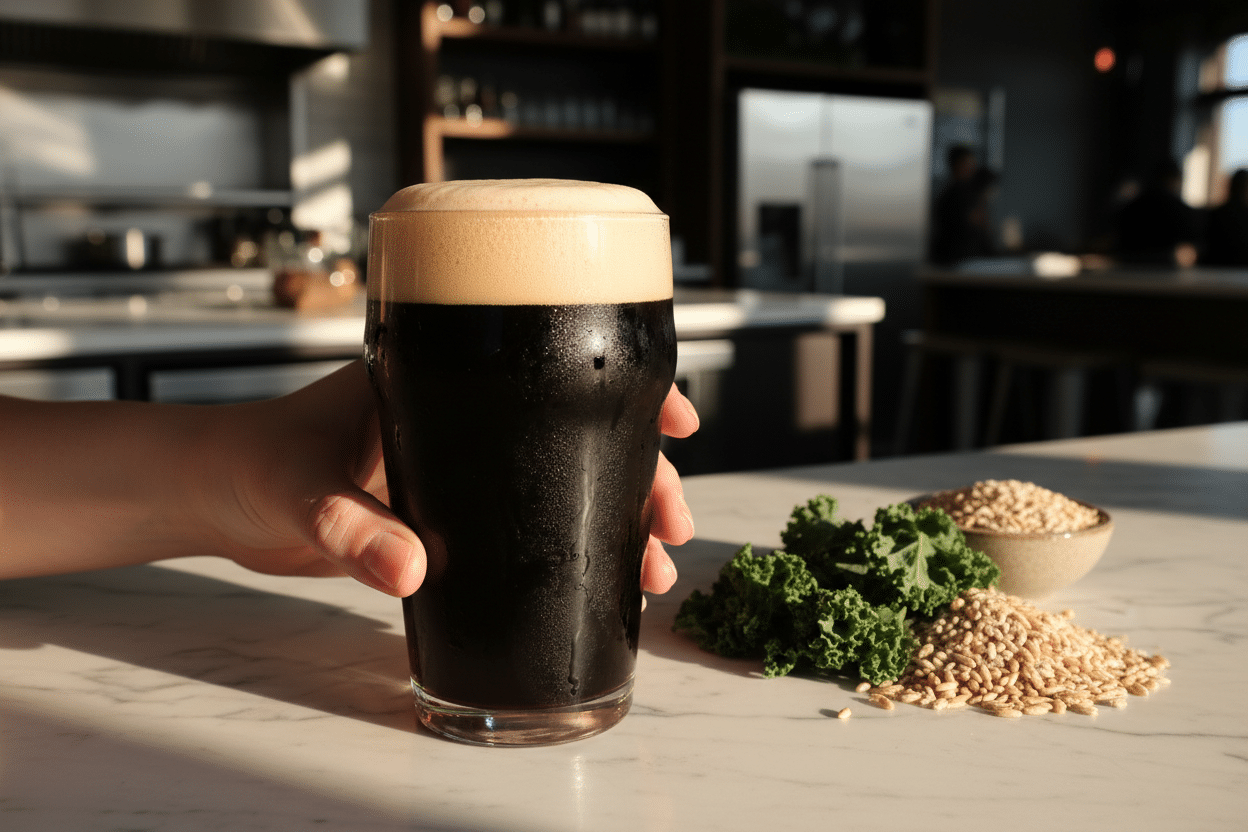
The defining ingredient in Guinness Draught is roasted barley, which is malted barley that has been kilned at high temperatures until it darkens significantly. This roasting process produces the deep ruby-black color that appears opaque in a glass but reveals garnet tones when held to light. More importantly, it generates the coffee and dark chocolate flavor notes that define Guinness. Roasted barley also contributes to the beer's relatively dry finish — a characteristic that distinguishes it from sweeter stouts.
Nitrogen vs. carbon dioxide
Most beers are carbonated with CO2, which produces large, sharp bubbles and a crisp mouthfeel. Guinness Draught uses a nitrogen-CO2 blend, typically a ratio of roughly 75% nitrogen to 25% CO2. Nitrogen produces much smaller, finer bubbles that create a smoother, creamier texture. This is the physical reason behind that cascading visual effect and the dense, persistent head. From a nutritional standpoint, the gas blend itself adds no calories — but it fundamentally shapes the drinking experience and the perception of richness.
The alcohol by volume (ABV) of Guinness Draught sits at 4.2%, which is notably lower than many craft stouts and even some lagers. Alcohol is calorie-dense at 7 calories per gram, so a lower ABV directly contributes to a lower overall calorie count — a fact that surprises many drinkers who assume a dark, rich-tasting beer must be high in calories.
How many calories are in a pint of Guinness
A standard UK pint (568ml) of Guinness Draught contains approximately 198 calories. A US pint (473ml) comes in around 165 calories. These figures place Guinness firmly in the lower tier of calorie counts for draft beers, despite its reputation as a "meal in a glass" — a myth that has persisted for decades but has no basis in the nutritional reality.
in a standard UK pint (568ml) of Guinness Draught
Breaking down the Guinness nutrition profile
The Guinness nutrition breakdown per pint (568ml, Draught) looks roughly like this:
- Calories: ~198 kcal
- Carbohydrates: ~18g
- Protein: ~2g
- Fat: 0g
- Alcohol: ~18.8g
The carbohydrate content comes primarily from unfermented sugars and residual dextrins left after fermentation. These contribute body and mouthfeel. The protein trace comes from the barley. And the fat content is effectively zero — beer contains no fat. The calorie figure is dominated by alcohol, with carbohydrates making a secondary contribution.
Guinness Extra Stout (5.6% ABV) contains around 250 calories per pint — noticeably more than Draught, primarily because of the higher alcohol content. Foreign Extra Stout (7.5% ABV) pushes closer to 330 calories. The ABV is the primary driver of calorie differences across Guinness variants.
The health dimension of moderate beer consumption
The relationship between beer consumption and health is nuanced, and Guinness occupies an interesting position within that conversation. The bière irlandaise has been studied specifically in a few contexts, and the findings are more textured than a simple "good" or "bad" verdict.
What the research actually shows
A study published in the University of Wisconsin found that Guinness, consumed in moderation, showed potential for reducing blood clot formation — an effect attributed to antioxidant compounds derived from the roasted barley. These compounds, including flavonoids, function similarly to those found in red wine and dark chocolate. The key phrase, as always, is moderation. The study used moderate consumption as its baseline, and the findings do not extrapolate to heavier drinking patterns.
The B vitamins present in beer — including folate, niacin, and B6 — come from the yeast and grain. Guinness, with its relatively high grain content relative to its alcohol level, retains measurable amounts of these micronutrients. This is not a reason to drink beer as a dietary supplement, but it does complicate the narrative that beer is nutritionally inert.
Moderation as the operative concept
The health effects of alcohol are dose-dependent in ways that make sweeping generalizations unreliable. What the evidence consistently supports is that heavy consumption of any alcoholic beverage carries significant health risks: liver disease, cardiovascular damage, increased cancer risk. Moderate consumption — defined by most health organizations as one drink per day for women and two for men — sits in a more ambiguous zone where some studies show neutral or marginally positive effects on cardiovascular health, while others find no benefit.
The calories in Guinness matter in the context of total dietary intake. A single pint at 198 calories is comparable to a medium banana or a small serving of rice. It is not a negligible addition to a day's intake, but it is far from the caloric bomb that the beer's reputation suggests.
Guinness and gastronomy: food pairings that work
The culinary dimension of Guinness is underexplored, and it deserves serious attention. The beer's roasted bitterness, coffee notes, and dry finish make it a versatile partner at the table — both as a beverage pairing and as a cooking ingredient.
Classic food pairings with Guinness
The most intuitive pairings leverage contrast and complement. Guinness's roasted bitterness cuts through the fat of rich, savory dishes in the same way that tannins in red wine cut through a ribeye.
Oysters are the canonical Guinness pairing, and for good reason. The briny, mineral quality of a fresh oyster amplifies the roasted grain notes in the beer, creating a synergy that neither element achieves alone. This pairing has deep roots in Irish coastal culture, where both products were historically abundant and affordable.
Beef stew with Guinness — the dish that has become a staple of Irish pub menus globally — works because the beer's bitterness and roasted character add depth to braised meat. The alcohol evaporates during cooking, leaving behind complex flavor compounds that enrich the sauce. The result is a dish with a savory depth that water or standard stock cannot replicate.
Aged cheddar and hard cheeses pair well because their sharpness and salt content find balance in the beer's bitterness. Dark chocolate — particularly varieties above 70% cacao — echoes the beer's own chocolate notes and creates a coherent dessert pairing.
Guinness as a cooking ingredient
Beyond the glass, Guinness functions as a legitimate culinary tool. It works as a braising liquid for lamb shoulder, a base for onion soup, a marinade for beef short ribs, and a flavor enhancer in bread doughs. Guinness bread — a dense, slightly sweet soda bread made with stout — is a straightforward introduction to cooking with the beer. The sugars in the stout feed the bread's rise, and the roasted notes add a complexity that plain water cannot provide.
When cooking with Guinness, use Guinness Draught rather than Extra Stout. The Draught variant has a softer, less bitter profile that integrates more smoothly into sauces and braises. Extra Stout can introduce an aggressive bitterness that overwhelms delicate dishes.
Guinness across the world: one beer, many meanings
The culture de la bière surrounding Guinness shifts dramatically depending on geography. The brand sells in over 150 countries, and the way it is consumed, perceived, and integrated into local culture varies in ways that reveal as much about those cultures as about the beer itself.
Nigeria: the world's second-largest Guinness market
Nigeria is, by volume, the second-largest market for Guinness in the world. But the Guinness consumed in Lagos is not the same product poured in Dublin. Guinness Foreign Extra Stout, brewed locally at higher strength, dominates the Nigerian market. The beer's image there is tied to masculinity, vitality, and social status — a positioning that differs entirely from its Irish heritage narrative. Local brewing operations, established in 1963, have made Guinness a genuinely Nigerian product in cultural terms, even as the brand identity remains anchored in Ireland.
The United States: craft beer context
In the American market, Guinness occupies a paradoxical position. For decades, it served as many drinkers' introduction to dark beer — a gateway stout for a market dominated by pale lagers. The craft beer explosion of the 2000s and 2010s complicated that role. American craft stouts and imperial stouts arrived with far more aggressive flavor profiles and higher alcohol content, making Guinness look restrained by comparison. The brand responded with the Open Gate Brewery in Baltimore and a range of experimental beers, attempting to reclaim relevance in a fragmented market.
The global St. Patrick's Day phenomenon
Perhaps the most vivid illustration of Guinness's global cultural reach is St. Patrick's Day. On March 17th, an estimated 13 million pints of Guinness are consumed worldwide — compared to approximately 5.5 million on a typical day. This is not an Irish phenomenon alone. It happens in Tokyo, São Paulo, Sydney, and Cape Town. The day has become a global performance of Irishness in which Guinness serves as the central prop, consumed by people who may have no Irish ancestry whatsoever. The beer has become a cultural shorthand for a particular idea of conviviality and tradition that transcends its origins.
The calories in a pint of Guinness are a reasonable thing to know. But they are the least interesting thing about what ends up in the glass.