
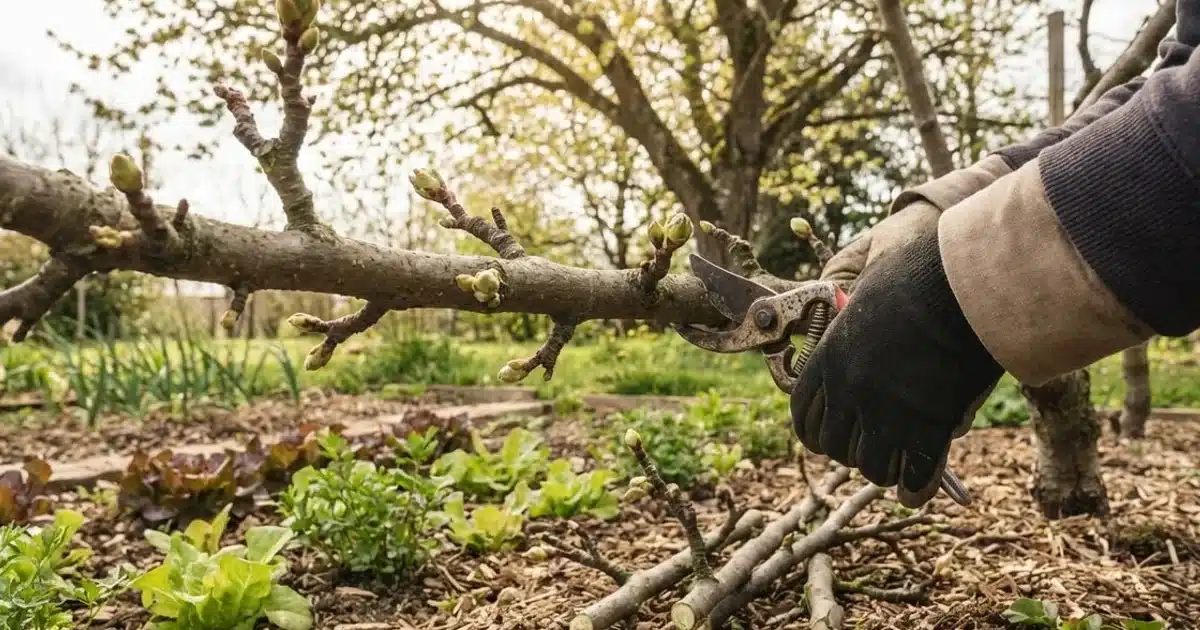
Pruning fruit trees in March seems straightforward, but a single mistimed cut with your shears can cost you an entire season's harvest. Four specific mistakes — made by well-meaning gardeners every year — silently destroy flower buds, invite disease, and leave trees too exhausted to produce fruit worth picking.
March is a deceptive month in the garden. The first warm days arrive, the soil smells alive again, and the urge to grab the pruning shears and tidy up the orchard feels completely natural. But that impulse, acted on too quickly or too aggressively, can undo months of growth before it even begins. According to experts at Maison & Travaux, the timing, quantity, and placement of every cut made this month determines whether your cherry, plum, peach, raspberry, blueberry, or vine plants reward you come summer, or simply survive the season in recovery mode.
The timing mistake that exposes trees to frost damage
The first and most common error is picking up the shears during the very first warm spell of late winter. Temperatures climb above 10°C for a few days, the buds start swelling, and it looks like spring has arrived. But nights are still dropping below zero, and that gap between day and night temperatures is precisely where the damage happens.
When you make cuts during this window, you expose living tissue to freezing air. The tree immediately mobilizes its energy reserves to begin healing those wounds, reserves that were meant to fuel flowering and early growth. The result is a delayed vegetative restart, reduced flowering, and a noticeably thinner harvest. Concrètement, a cherry tree pruned during a frost-interrupted thaw in early March may bloom two weeks late and set far fewer fruits than one left untouched until conditions stabilize.
The recommendation from Maison & Travaux is clear: wait for a confirmed frost-free window, and only work in dry weather. Wet conditions after pruning create the perfect entry point for fungal infections.
The critical date: around March 10
The 10th of March acts as a rough dividing line. Before that date, light interventions on stone fruit trees are acceptable if the weather cooperates. After it, sap flow in most species has already restarted in earnest, and any major cuts on cherry or plum trees will cause the wood to "weep," bleeding sap from the wound. That weeping exhausts the tree and creates conditions favorable to gommose and fungal colonization. For stone fruit trees specifically, heavy structural pruning belongs in summer, immediately after harvest, not in March.
Removing the wrong wood costs you the entire fruit crop
The second critical mistake is cutting off what looks like last year's thin, somewhat untidy shoots. Those are exactly the branches you must keep. The flower buds for this season's fruit are carried on wood produced the previous year. Removing those shoots in a general tidying effort means removing every blossom before it opens. No blossoms, no fruit. The tree looks neat in April and produces nothing in August.
This is especially relevant for raspberries and blueberries, where the fruiting wood is visually easy to confuse with dead or weak growth. Before cutting anything, identify which stems are carrying swollen buds. Those are untouchable until after fruiting.
Never remove shoots from the previous season without checking for flower buds first. On cherry, plum, and peach trees, those buds are your entire harvest for the year.
What you can safely cut in March: dead wood, branches that cross and rub against each other, and poorly placed structural branches that block light penetration. The guiding principle is transparency — when you step back and look up through the canopy, you should be able to see patches of sky between the branches. That light access directly determines fruit size, flavor concentration, and the health of any vegetables growing at the base of the tree.
Cutting too much at once triggers a cascade of problems
Even when gardeners cut the right branches, they often cut too many. Removing more than approximately 25% of the living canopy in a single session triggers a stress response that consumes the entire growing season.
What happens when the threshold is crossed
The tree shifts its energy away from fruit production and toward rebuilding its crown. That means an explosion of vertical, non-fruiting shoots called water sprouts, a denser canopy that traps humidity, more shade cast over the vegetable garden below, and fruits that are smaller and noticeably more acidic than normal. The dense, humid foliage also creates favorable conditions for fungal disease later in the season.
The 25% rule applies per session, not per year. If a tree genuinely needs more structural work, it is far better to spread the intervention over two or three seasons than to try to correct everything at once.
Tool hygiene matters as much as technique
A poorly sharpened pruning shear tears tissue rather than cutting it cleanly. Torn edges take longer to seal and are more vulnerable to infection during the healing period. Beyond sharpness, disinfecting the blade with alcohol between each tree prevents the direct transfer of fungal spores from one plant to another. This step takes thirty seconds and eliminates a significant transmission risk that most home gardeners overlook entirely. Just as you might wonder whether plastic wrap is safe to use in the kitchen before handling food, basic hygiene with garden tools deserves the same reflexive attention.
reduction in aphid and codling moth attacks with a white trunk wash applied in early March
A simple trunk treatment that reduces pest pressure by 40%
Beyond the shears, early March is the right moment for one additional gesture that most gardeners skip entirely: brushing the trunks and applying a white lime wash (badigeon blanc) to the bark. This treatment, applied at the start of the month, reduces attacks from aphids and codling moths by up to 40% according to the source data.
The mechanism is straightforward. The white coating reflects light and disrupts the thermal environment that overwintering pest eggs and larvae depend on. It also seals minor bark fissures that would otherwise serve as entry points for disease. Brushing the trunk first removes loose bark, moss, and debris that harbor pests, making the wash more effective. For anyone growing fruit trees alongside a kitchen garden and hoping to make the most of seasonal harvests throughout the year, this is one of the highest-return actions available in early spring.
The complete March approach for fruit tree pruning comes down to three questions for every tree: Is the timing right (no frost forecast, dry weather)? Is the quantity within limits (no more than a quarter of living growth)? And does every cut improve light distribution through the canopy? Answer those three questions correctly, and the pruning shears become a tool for abundance rather than a source of damage that takes years to undo.